Posts

Showing posts with the label medications: oral & topical

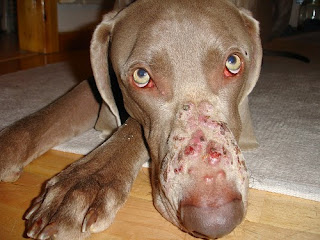
What is Folliculitis?
Image
Yes, even dogs can get folliculitis. Folliculitis is a persistent infection caused by either bacteria or possibly a fungus within the hair follicle. It occurs due to shaving , long-term irritation , or even restrictive or tight clothing . Folliculitis should not be confused with pseudofolliculitis barbae , otherwise known as ingrown hair . This happens due to hair curling back down into the follicle wall instead of coming up out onto the skin’s surface, which is the reason pseudofolliculitis barbae tends to occur more often with African-American males or any men with curly hair. Believe it or not, there is a condition called hot tub folliculitis or pseudomonas folliculitis . Like standard folliculitis, it is a bacterial infection within the hair follicle, but as the name implies, it is contracted by sitting in a hot tub! Usually the infection is located where the water meets the skin; around the neck, upper arms, and upper back areas. I actually know several client...

Dermatitises (skin inflammations) explained

Image
Dermatitis is an umbrella term describing a general condition of inflammation ( itis ) of the skin ( derma ). If you think you have a form of dermatitis, go see your dermatologist. He or she will be able to prescribe medication (usually topical) that can help get rid of this often annoying skin condition. Let’s look at the different types of dermatitis. I first want to say that all of the photos in this post are very bad cases of each individual dermatitis. Many of you will only have shades of what you see below. I put the worst-case scenarios here so you can see what each skin condition looks like. Minor examples simply wouldn’t exemplify these skin irritations like the bad cases do. My hope is that you never have the type of severe cases shown here! Allergic contact dermatitis. This dermatitis goes by the names contact dermatitis , allergic dermatitis , and allergic contact dermatitis . No matter which name you prefer, the symptoms are the same. Allergic c...

Treating Rosacea: Eliminate? Control? Fix? Cure?

Image
How do I fix/control/treat rosacea? Instead of trying to eliminate rosacea, start thinking in terms of managing it. Rosacea can’t be cured, but it can be controlled. If you are constantly looking for the symptoms of rosacea to completely go away, you may be setting yourself up for disappointment. I am in no way saying that it isn’t possible for your rosacea to disappear, but realistically it might be more advantageous for you to see rosacea as being an ally , continually relaying messages to you about the state of your internal health. This of course includes the amount of stress in your life. I am not trying to trivialize something that is serious. I am really trying to guide you to a new way of thinking; I also want you to understand that your body is constantly sending you signals about what it likes, what it doesn’t like, and how it is handling everything you are feeding it and asking it to do for you. This relationship (between you and your body) needs to be a clos...

Oral Antibiotics: Good for clearing up your skin or not?

Image
Below are two stories of clients who have been on antibiotics for their skin problems (long-term) and the issues this course of treatment can bring. Hopefully this will be helpful information to keep in mind if you are on antibiotics for your skin—especially if you’ve been taking them for a long time. Sara’s story. My client Sara has been on tetracycline for at least two years for problem skin. However, after talking with her, I found that her skin problems are very intermittent and occasional. Once her dermatologist suggested Accutane, but Sara’s problems weren’t severe, and from what she knew about that medication she thought Accutane sounded like overkill. She went on to tell me she had a hysterectomy at 27 years of age due to complications with her ovaries, and since then she has had over eight surgeries for endometriosis. This information shows something is inherently out of whack with Sara’s body. Most likely she has a hormone imbalance, which can adversely affect the...

Retin-A—some basic info

Image
What is Retin-A?   Tretinoin is a synthetic derivative of vitamin A , related to a class of chemicals called retinoids . Most people are acquainted with the brand names Retin-A ® and Renova ® , so I will use these more familiar names when talking about tretinoin. Retin-A helps dissolve the bonds connecting your skin cells together. This increases cell turnover and can help to unplug the pores . Because of this dissolving action, Retin-A will help make the skin feel smoother as well as counteract the formation of blemishes . In contrast, in many people it also causes mild to severe irritation that leads to peeling or flaking skin. Your skin may feel smooth, but it may also look red and scaly . Retin-A is basically an irritant, and your skin responds as such. Many studies have been performed on the attributes and possible side effects of Retin-A, several touting its ability to stimulate collagen production. It is also said to encourage the development of...